
Acro News & Information
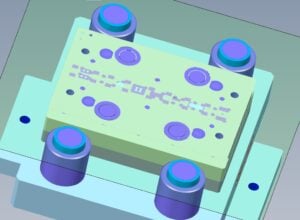
Recreate Chinese Designed Tooling
A customer needed USA made components for Buy American requirements. After discussing their needs for a small reel to reel terminal made in a 2-Out Progressive die; the best solution wound up being just taking the tooling die design already proved out in China and building an exact duplicate in Milwaukee, WI.
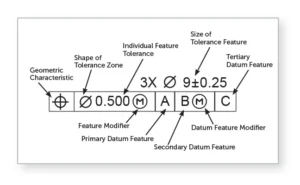
Understanding Tolerances in Metal Stamping
What Engineers and Manufacturers Need to Know In metal stamping, precision is often critical to how a component performs in the finished assembly. A stamped metal part may need to fit around another component, maintain a precise electrical connection, accommodate a press-fit bushing, or meet specific dimensional requirements throughout high-volume production. Metal stamping tolerances define how much a finished part is allowed to vary from its specified dimensions while still meeting the requirements of the…
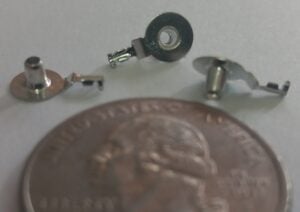
Deep Draw 1mm Wide x 3mm Deep
Deep Drawing a Tiny Brass part almost 3 times deeper than it is wide required more than10 Draw Stations. This was a very challenging part that defied what most of our software told us would be required to produce. Human trial and error is still required in a lot of instances. The saying “More Art, Than Science” still applies to metal stamping in a lot of instances

Specifying Metal Inserts For Injection Molding
How Plastic and Rubber Injection Molders Should Choose Metal Inserts for Their Parts In plastic and rubber injection molding, the metal insert is often one of the most critical components in the finished assembly. Whether the insert is used for threading, electrical conductivity, structural reinforcement, wear resistance, grounding, or mounting, the wrong insert choice can lead to cracking, pull-out failures, corrosion, dimensional instability, or premature product failure. For OEMs and molders alike, selecting the correct…
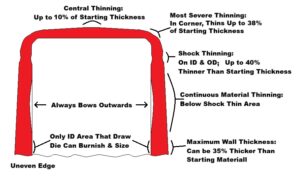
How Material Stretches When Deep Drawn
Diagram of Material Thinning In Deep Draw How Material Thins During Deep Drawing: What Engineers Need to Know Deep drawing is one of the most efficient and precise metal forming processes used in modern manufacturing. It allows flat sheet metal to be transformed into cups, cans, housings, shells, and complex cylindrical or rectangular shapes with excellent repeatability. At Acro Metal Stamping, deep drawing is a core capability used to produce tight-tolerance components for demanding…

Reel to Reel Plating Expertise
Reel-to-Reel Plating for Precision Metal Stampings High-Volume, Cost-Effective Finishing from Acro Metal Stamping Reel-to-reel plating-also known as continuous strip plating-is one of the most efficient and consistent methods for finishing stamped metal components. For high-volume applications, it offers a combination of speed, uniformity, and cost savings that batch plating processes simply cannot match. At Acro Metal Stamping, reel-to-reel plating is a key capability used to deliver high-quality plated components for electrical, automotive, and industrial…

ISO 9001:2015 ReCert
We recently completed our 3 Year ISO 9001:2015 Recertification with Zero Nonconformances! We are so proud of our team that not even one Minor non-conformance was found in 2 day audit. Download New ISO Cert PDF
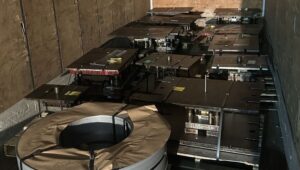
More Dies Sent To Acro
When a Customer Sends “The Rest” of the Dies: What That Really Means In metal stamping, trust isn’t built with promises. It’s built with parts. Recently, we had a customer send us the last of their remaining dies after we successfully took over production on their initial tool transfer. That moment says more than any sales pitch ever could – and it highlights what really matters when transferring customer-owned tooling. This wasn’t just a…

Pre-Tempered vs. Post-Heat-Treated Metal Stamping
Design & Manufacturing Expertise from Acro Metal Stamping Choosing whether to stamp parts from pre-tempered material or to heat treat after stamping is one of the most important decisions in precision metal stamping. The choice affects part performance, tooling cost, dimensional stability, lead time, and long-term quality. At Acro Metal Stamping, we help engineers and purchasing teams make the right decision early-avoiding unnecessary secondary operations, tooling issues, and redesigns. With decades of experience stamping spring…
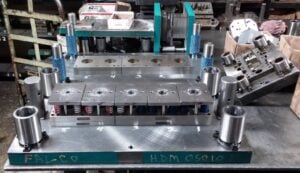
Specialize In Customer Owed Tooling
Acro Metal Stamping: The Ideal Partner for Transferring Your Customer-Owned Tooling In the world of precision metal stamping, tooling ownership and performance are two of the most critical factors that determine production success. For manufacturers who rely on external stampers, the need to transfer dies-whether due to capacity constraints, quality challenges, or a stamper closing their doors-is a reality that demands a reliable partner. That’s exactly where Acro Metal Stamping shines. With over 80 years…
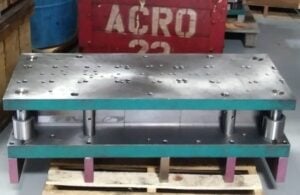
Do I Own My Tool?
Tooling Ownership in Metal Stamping: What Customers Should Know-and How We Handle It In metal stamping, tooling is everything. Progressive dies and form tools represent a major investment; and play a critical role in part quality, consistency, and long-term supply stability. Yet one of the most common-and most misunderstood-questions customers have is: “Do we own the tooling?” At Acro Metal Stamping, we believe tooling ownership should never be ambiguous. Clear expectations protect both the customer…
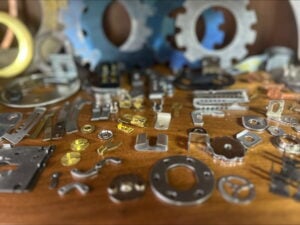
Updated Metal Part Costs Guide
Download PDF Below are the primary factors that influence the total cost of a metal component-from concept through production. Understanding these drivers helps identify opportunities for cost reduction without sacrificing performance or reliability. 1 Production Method – Often the Largest Cost Driver Production method is typically dictated by volume, but tolerances, material type, geometry, design complexity, and functional requirements also influence the choice. Approximate order of decreasing cost (highest → lowest): Machining Metal Fabrication (laser,…

MANUFACTURED IN THE USA

TIGHTER TOLERANCES

IN-HOUSE TOOL ROOM
