
Specifying Metal Inserts For Injection Molding
How Plastic and Rubber Injection Molders Should Choose Metal Inserts for Their Parts
In plastic and rubber injection molding, the metal insert is often one of the most critical components in the finished assembly. Whether the insert is used for threading, electrical conductivity, structural reinforcement, wear resistance, grounding, or mounting, the wrong insert choice can lead to cracking, pull-out failures, corrosion, dimensional instability, or premature product failure.
For OEMs and molders alike, selecting the correct metal insert requires more than simply choosing a material and size. Insert geometry, base alloy, plating, tolerances, and manufacturing method all directly impact molding performance and long-term durability. By involving an experienced precision metal stamping supplier early in the design process, injection molders can reduce total cost while improving product reliability.
Start with the Application Requirements
The first step in selecting a metal insert is understanding the final application environment. The insert must perform not only during molding, but throughout the product’s life cycle.
Questions molders should evaluate include:
- Will the insert experience repeated torque or mechanical loading?
- Is the assembly exposed to moisture, chemicals, or outdoor conditions?
- Does the insert need electrical conductivity or grounding capability?
- Will the product experience high temperatures or thermal cycling?
- Is weight reduction important?
- Does the insert need to bond tightly to the molded material?
- Will the insert be visible in the finished assembly?
For example, a brass insert may perform well in consumer electronics because of its conductivity and corrosion resistance, while a stainless steel insert may be better suited for automotive under-hood environments requiring higher strength and heat resistance.
Understanding these conditions early helps narrow the material and manufacturing options before tooling begins.
Material Selection Matters
The insert material directly affects strength, corrosion resistance, conductivity, machinability, and compatibility with the molded resin or rubber compound.
Common insert materials include:
Brass
Brass is one of the most widely used insert materials for plastic injection molding because it offers:
- Excellent corrosion resistance
- Good electrical conductivity
- Easy machining and forming
- Reliable thread performance
- Competitive cost
Brass inserts are commonly used in electronics, consumer goods, connectors, and appliance components.
Stainless Steel
Stainless steel inserts provide:
- High mechanical strength
- Superior wear resistance
- Excellent corrosion protection
- Better high-temperature performance
These inserts are common in medical, industrial, aerospace, and automotive applications where durability is critical.
Carbon Steel
Carbon steel inserts are often selected when:
- High strength is required
- Cost reduction is important
- Plating can provide adequate corrosion resistance
Zinc-plated or nickel-plated carbon steel inserts are frequently used in high-volume applications where environmental exposure is limited.
Copper and Specialty Alloys
Copper alloys may be selected for applications requiring enhanced conductivity, EMI shielding, or thermal transfer performance.
Specialty alloys can also be used for demanding environments involving chemicals, vibration, or extreme temperatures.
Insert Geometry Is Critical
The shape of the insert plays a major role in retention strength and molding consistency. A poorly designed insert may rotate, loosen, or pull out under load.
Common retention features include:
- Knurls
- Undercuts
- Grooves
- Holes
- Serrations
- Barbs
- Flanges
These features help the molded material mechanically lock onto the insert during the injection process.
For thermoplastics, aggressive knurl patterns often improve torque and pull-out resistance. In rubber molding, larger undercuts or holes may improve bonding by allowing rubber to flow through and encapsulate the insert.
Insert geometry must also account for resin shrinkage and thermal expansion differences between the metal and molded material.
Consider the Molding Process
Different molding methods place different demands on inserts.
Insert Molding
In insert molding, the metal component is placed into the mold before injection. This requires:
- Tight dimensional consistency
- Reliable automation compatibility
- Accurate positioning features
- Resistance to movement during injection pressure
Stamped inserts are often ideal for high-volume insert molding because they offer excellent repeatability and lower piece-part costs compared to machined components.
Overmolding
Overmolding places plastic or rubber over an existing metal substrate. In these applications, surface preparation and adhesion become especially important.
Surface texturing, perforations, and specialty plating may improve bonding between the insert and molded material.
Rubber Molding
Rubber molding can expose inserts to elevated temperatures and compression forces during vulcanization. The insert material and finish must withstand these conditions without scaling, distortion, or contamination.
Plating and Surface Finish Can Improve Performance
Insert plating is often overlooked during early design stages, but it can significantly impact both molding and field performance.
Common plating options include:
- Nickel plating for corrosion resistance and appearance
- Tin plating for solderability
- Zinc plating for economical corrosion protection
- Silver plating for conductivity
- Gold plating for high-reliability electrical applications
Surface finish also affects adhesion and bonding. In some cases, roughened or textured surfaces improve mechanical retention within the molded material.
However, excessive plating thickness or inconsistent coating can create dimensional problems, particularly for precision threaded inserts.
Working closely with both the molder and insert manufacturer helps ensure plating specifications support the application requirements.
Precision Tolerances Improve Automation
Modern injection molding operations increasingly rely on automation for insert loading and part handling. Consistent insert dimensions are essential for preventing jams, misfeeds, and downtime.
Precision metal stampings often provide advantages including:
- Tight repeatability
- High-volume scalability
- Lower variation
- Improved automated feeding
- Reduced secondary machining
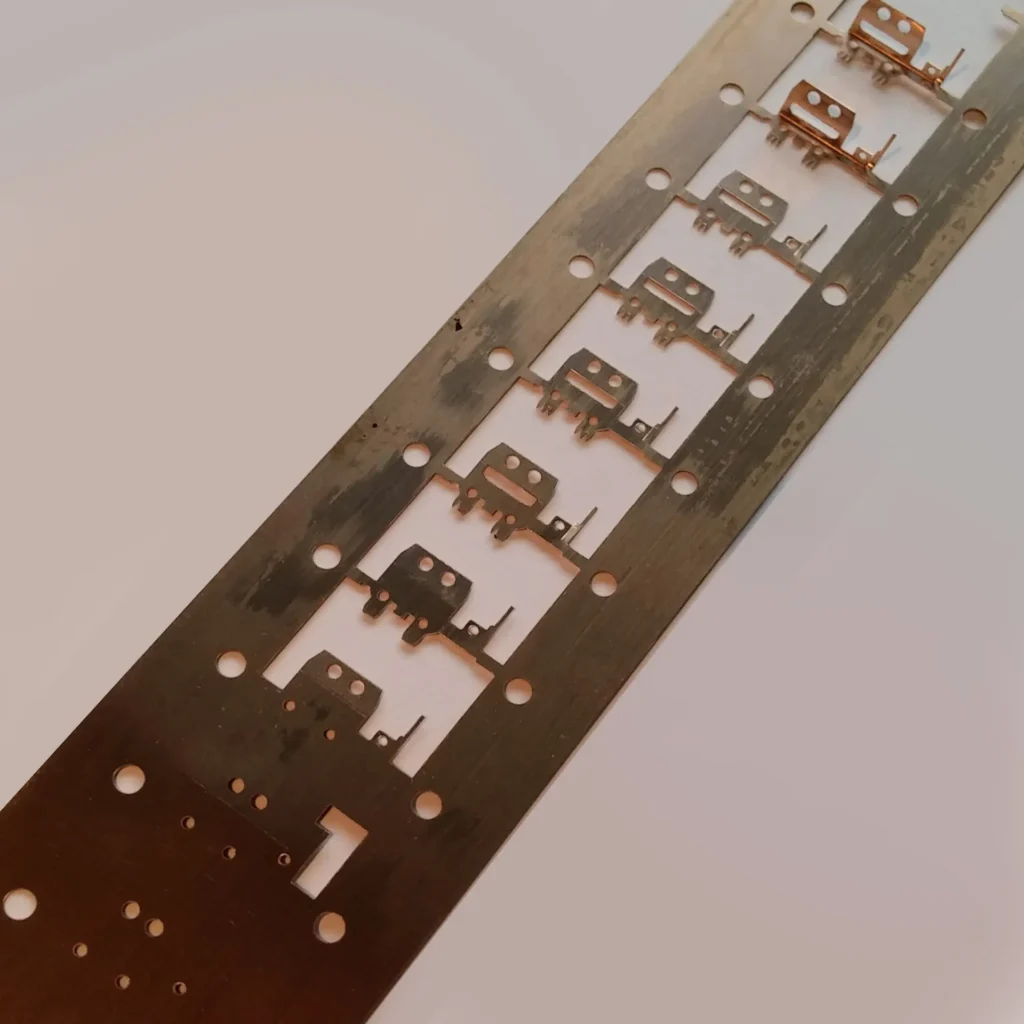
Progressive die stamping is especially effective for thin-gauge inserts, terminals, shields, retainers, and complex formed geometries used in molded assemblies.
When inserts are inconsistent, even minor dimensional variation can disrupt robotic loading systems and create costly production interruptions.
Early Supplier Collaboration Reduces Cost
One of the biggest mistakes OEMs and molders make is finalizing the molded component design before consulting the insert supplier.
Early collaboration can help optimize:
- Insert geometry
- Material selection
- Tolerances
- Plating requirements
- Feeding orientation
- Packaging
- Assembly methods
In many cases, a stamped insert can replace a more expensive machined component while maintaining the same functional performance.
Design-for-manufacturability reviews often uncover opportunities to reduce material usage, eliminate secondary operations, or improve molding efficiency.
Quality Control Is Essential
Because inserts become permanently encapsulated within the molded component, defects are difficult or impossible to repair after molding.
Critical quality considerations include:
- Burr control
- Dimensional inspection
- Plating verification
- Material certification
- Thread inspection
- Flatness and concentricity
- Cleanliness
A high-quality insert supplier should maintain robust quality systems and process controls to ensure consistency across production volumes.
For many applications, even minor burrs or contamination can interfere with mold sealing, resin flow, or assembly performance.
The Right Insert Improves the Entire Assembly
Metal inserts may represent a small percentage of the total assembly cost, but they often play a major role in product performance and reliability.
Choosing the right insert involves balancing:
- Mechanical requirements
- Environmental exposure
- Manufacturability
- Automation compatibility
- Material cost
- Long-term durability
By partnering with an experienced precision metal stamping manufacturer, injection molders can develop inserts optimized for both production efficiency and end-use performance.
At Acro Metal Stamping Co., we work with OEMs, plastic injection molders, and rubber molders to manufacture precision metal inserts, terminals, retainers, contacts, and custom stamped components designed for demanding molded assemblies. Our team supports customers from prototype through high-volume production with a focus on quality, repeatability, and cost-effective manufacturing.