
Updated Metal Part Costs Guide
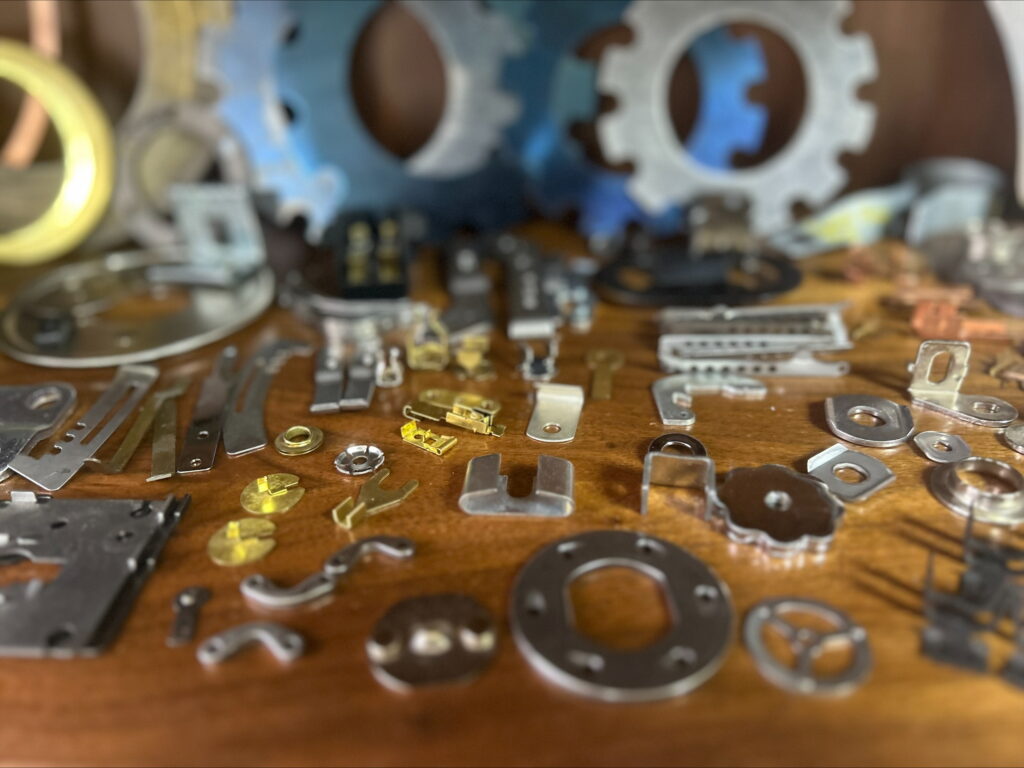
Below are the primary factors that influence the total cost of a metal component—from concept through production. Understanding these drivers helps identify opportunities for cost reduction without sacrificing performance or reliability.
1 Production Method — Often the Largest Cost Driver
Production method is typically dictated by volume, but tolerances, material type, geometry, design complexity, and functional requirements also influence the choice.
Approximate order of decreasing cost (highest → lowest):
- Machining
- Metal Fabrication (laser, plasma, waterjet, turret press, press brake)
- Casting
- Stamping
Choosing the most appropriate process can significantly reduce part cost, especially when transitioning from low-volume methods (machining/fabrication) to high-volume stamping.
2 Secondary Operations & Vendor Consolidation
Each additional process adds cost, handling, and risk. Review the full manufacturing sequence and ask:
- Can multiple operations be combined into one?
(Example: progressive tooling vs. multiple single-hit operations.) - Are parts shipped to multiple outside vendors (plating, coating, machining, etc.)?
Consolidation often reduces freight, handling, and administrative overhead. - Could pre-coated materials meet performance requirements and eliminate downstream finishing?
- Is automation feasible at present or future volumes?
- How many human touches occur from raw material to finished part?
Reducing hand-offs, vendors, and manual steps is often one of the largest cost-reduction opportunities.
3 Material Selection — Always Ask “Why This Material?”
Material choice should begin with performance objectives, then refine toward cost. “Why This Grade?” & “Why This Temper?”. Some Common cost-saving considerations:
- High Carbon Steel like 1050 is sometimes a suitable substitute for HSLA d
- Brass is typically less expensive than copper while offering similar conductivity and corrosion performance in many applications.
- Do you truly need 300-series stainless, or would a lower-cost grade (e.g., 430, or 200-series) meet corrosion, strength, and cosmetic requirements?
Material is often one of the top three cost drivers—optimizing it early pays dividends.
4 Tolerance, Dimensional Variation & Process Capability
Tolerance stack-ups can unintentionally drive processes, tooling complexity, and quality inspection costs.
- Did default CAD/title-block tolerances get applied without review?
- Which dimensions are functionally critical, and which are not?
- Would a slightly wider tolerance still meet performance goals?
- Are You Using GD&T guidance (which callouts dramatically increase cost)?
- Does material thickness variation affects formed features?
Example: Calling out 0.060" ± .001" steel can be significantly more expensive than specifying 16 gauge stock when exact thickness is non-critical.
Right-sizing tolerances may allow a simpler process (see Section 1), fewer secondary operations (Section 2), and reduced inspection burden (Section 5).
5 Surface Finish & Cosmetic Requirements
Surface specs often quietly drive cost. Ask Yourself how important the Aesthetics are:
- Define Finish: Mill finish vs. polished vs. coated vs. blast, etc.
- How cosmetic inspection requirements impact cost
- How certain finishes increase scrap rates
6 Quality Control Requirements
When estimating part cost, consider both direct QA costs and indirect nonconformance costs:
- Supplier inspection time (Define Sampling Plan)
- Your internal inspection time (Define Sampling Plan & Rejection Points)
- Cost of scrap, rework, or line disruptions
- Cost of field failures or warranty issues
- Additional documentation (PPAP, FAIRs, special reporting, etc.)
Example: Production Quality & Inspection Frequency to ISO 2859-1 AQL Level II 1.0 for Critical & 4.0 for Non-Critical Dimensions
Balancing upfront inspection requirements with risk tolerance often reveals more accurate total cost of ownership.
7 Design Review & Early Supplier Involvement (ESI) Recommendations
A part’s design can evolve over time — prototype → production → long-term use. Periodic review can uncover outdated or unnecessary features.
- When did you involve the Manufacturer in the Design Process
- Which features or operations actually drive cost?
- Are any bends, cutouts, inserts, tolerances, or finishes no longer required?
- Could two components be combined into one?
Design simplification is one of the most effective long-term cost-reduction strategies.
8 Similar or Related Parts
Do similar parts exist across different product lines, vendors, or tooling sets? Combining, standardizing, or consolidating similar components can:
- Reduce tooling and inventory
- Lower per-part pricing
- Simplify production scheduling
- Reduce supplier load and lead times
Standardization is especially impactful in high-volume environments.
9 Lead Time & Ordering Strategy
Lead time practices directly influence total cost:
- Are you aligned with your supplier’s optimal lead times?
- Are frequent expedites increasing material and labor costs?
- Can larger order quantities unlock significant raw material price breaks?
- For Kanban/JIT:
- What is the tradeoff between supplier carrying cost vs. your cost of capital (TVM)?
Optimizing lead times often yields substantial hidden cost savings.
10 Packaging & Shipping Considerations
Packaging and freight are often overlooked in early design stages.
- Could small design changes improve pack density and reduce shipping volume?
- Do packaging requirements (bags, separators, rust preventatives, custom dunnage) add avoidable cost?
- How many times do receiving personnel handle the parts?
- What is the optimal replenishment rate for this specific component?
Packaging-aware design can significantly reduce total landed cost.
11 Lifecycle Cost Perspective
Don’t Just think about “what is the piece price?” Think about:
- Total cost of ownership (TCO) template. Amortized Tooling or Tooling Replacement
- Risk costs: supply interruptions, late deliveries, tooling downtime
- Cost of poor quality (COPQ) structure
- Sustainability & Scrap Reduction
- Environmental impact of material choices
- Scrap minimization practices (DFM, nesting, coil selection)
- Recycled content considerations
- How weight reduction affects cost and sustainability
Final Note
Suppliers can often find meaningful cost reductions — but only if they fully understand the part’s functional requirements, performance expectations, and true operating environment. The more transparent the collaboration, the greater the potential savings.