
Electrical Terminal Stamping Process

Copper electrical terminals are fundamental components in electrical and electronic systems, providing the interface between conductors and devices. High-volume production of these terminals requires precision, repeatability, and cost efficiency, all of which are achieved through progressive die stamping. This article details the materials, tooling design, process flow, quality control, and post-processing steps involved in the stamping of copper terminals, with emphasis on the factors that influence electrical and mechanical performance.
1. Introduction
Electrical terminals must combine excellent electrical conductivity, mechanical strength, and corrosion resistance. They are produced in vast quantities for applications such as automotive wire harnesses, power distribution, and consumer electronics. Progressive die stamping has emerged as the most efficient manufacturing method for these components, allowing high-speed production with tight dimensional tolerances and consistent quality.
The process integrates material selection, die engineering, press operation, in-process quality control, and finishing operations. Each step contributes to the final terminal’s performance in service.


2. Material Selection and Preparation
2.1 Copper and Copper Alloys
Copper is selected for terminals primarily due to its high electrical conductivity (approximately 101% IACS for C11000 Electrolytic Tough Pitch copper) and formability. Common grades include:
-
C11000 (ETP Copper): Excellent conductivity and ductility.
-
Copper Alloys (e.g., C26000 Brass, C51000 Phosphor Bronze): Provide higher strength and spring properties for retention clips or contact springs.
Material is supplied as cold-rolled strip coil, typically 0.005–0.060 in. thick. The specified temper (annealed to full hard) directly affects forming behavior. Surface finish, flatness, and cleanliness are verified before stamping to ensure consistent feed and formability.
3. Die Design and Tooling Considerations
3.1 Progressive Die Configuration
Copper terminals are generally produced using progressive dies, which contain multiple workstations performing sequential operations as the strip advances through the press. Key operations include:
-
Blanking: Cutting the external profile of the terminal.
-
Piercing: Producing holes, slots, and openings for crimping or mating features.
-
Forming/Bending: Creating barrels, tabs, or locking tangs.
-
Coining/Embossing: Adjusting surface texture or contact area thickness for improved conductivity.
-
Cutoff: Separating the completed terminal from the carrier strip.
The strip remains attached to a carrier during forming to maintain positional accuracy. Modern die sets employ precision-ground tool steels (A2, D2, or carbide inserts) and are designed using CAD/CAM systems to optimize material flow, minimize distortion, and extend die life.
3.2 Alignment and Feed
Die design incorporates pilots and guide pins to ensure accurate strip advancement. Feed pitch is maintained within ±0.001 in. at each station. Automated lubrication reduces tool wear and helps achieve consistent forming loads.
4. Stamping Press Operation
4.1 Press and Feed Systems
The progressive die is installed in a high-speed mechanical or servo press, typically rated between 30 and 100 tons. Press speeds vary around 100 strokes per minute, depending on part geometry and material thickness.
The copper strip is fed from a coil through a decoiler, straightener, and precision roll feed into the die set. Each press stroke performs multiple simultaneous operations, forming one or more terminals per cycle. The resulting parts may remain on the carrier strip for reel-to-reel handling or be cut free automatically.
4.2 Process Monitoring
In modern production lines, load monitoring systems track tonnage signatures to detect tool wear, misfeeds, or material variation. Optical sensors verify strip presence and correct feed progression. These systems enable immediate shutdown or alarm conditions to prevent damage and ensure part quality.
5. In-Process and Post-Process Quality Control
5.1 Dimensional Verification
Initial and periodic first-article inspections confirm that terminal dimensions meet print specifications. Optical comparators, micrometers, or coordinate measuring machines (CMMs) are used to verify critical features such as crimp barrel width, tab thickness, and hole location.
Statistical process control (SPC) is often applied to high-volume production to detect drift or variation trends before they result in nonconforming parts.
5.2 Surface and Burr Control
Excessive burrs can compromise electrical connection or damage mating components. Punch-to-die clearance is optimized (typically 5–10% of material thickness), and tool edges are maintained sharp to minimize burr height. Where required, terminals undergo vibratory deburring or brush finishing.
6. Secondary and Finishing Operations
6.1 Cleaning and Heat Treatment
Following stamping, terminals are cleaned to remove oils and particulates using aqueous or ultrasonic methods. For certain alloys, annealing or stress-relief heat treatment is performed in a controlled atmosphere to achieve specified mechanical properties and minimize springback.
6.2 Electroplating
Plating enhances both conductivity and corrosion resistance. Typical coatings include:
-
Tin (Sn): Provides solderability and oxidation protection; cost-effective for most applications.
-
Nickel (Ni): Serves as a diffusion barrier and improves wear resistance.
-
Gold (Au): Used selectively for low-current, high-reliability signal contacts.
Reel-to-reel selective plating allows coating only the contact zones while leaving the remainder of the part unplated, reducing cost and maintaining crimpability.
7. Packaging and Automation Readiness
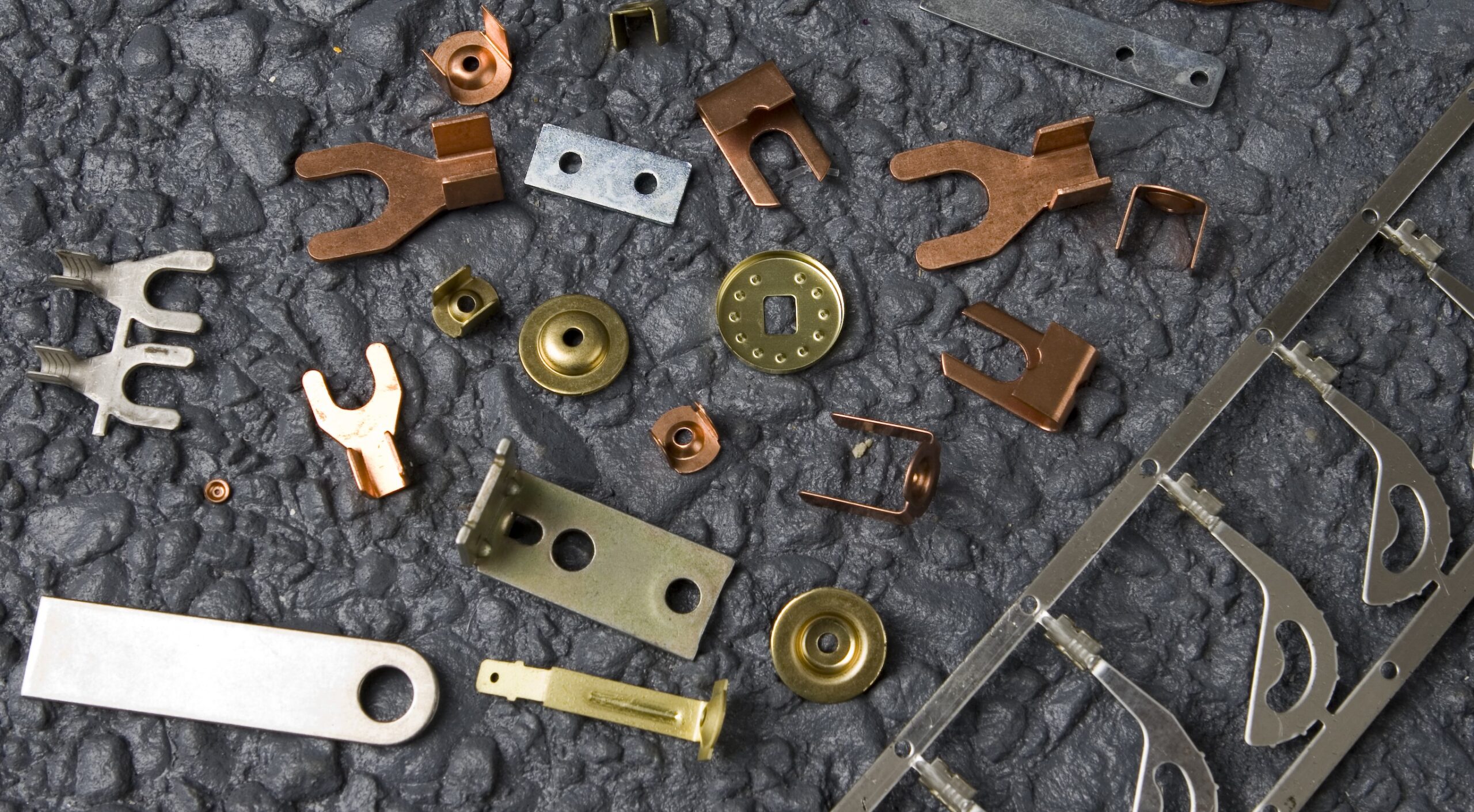
Finished terminals can be packaged loose or are wound onto reels with carrier strips intact, facilitating automated terminal insertion or crimping in downstream assembly operations.
Automated reel packaging ensures uniform tension and alignment, critical for uninterrupted feed in crimping or connector assembly equipment.
8. Process Challenges and Optimization
8.1 Tool Wear and Maintenance
Despite copper’s softness, prolonged high-speed operation leads to gradual tool wear, especially in fine piercing punches. Tool coatings such as titanium nitride (TiN) or chromium nitride (CrN) extend tool life and reduce galling. Regular preventive maintenance, including polishing and regrinding, is essential for dimensional stability.
8.2 Material Variation
Minor variations in strip thickness or hardness can affect forming consistency. Maintaining tight incoming material controls and collaborating with copper suppliers ensures predictable performance.
8.3 Process Integration and Automation
Modern stamping cells increasingly integrate data acquisition, vision inspection, and automated sorting. This digitalization enables predictive maintenance and real-time quality feedback, supporting Industry 4.0 objectives.
9. Environmental and Sustainability Considerations
Copper stamping generates recyclable scrap in the form of carrier strips and webbing. Nearly all of this material is reclaimed and reprocessed, minimizing waste. Closed-loop lubrication and aqueous cleaning systems further reduce environmental impact. The inherent recyclability of copper contributes to the sustainability of the process.
10. Conclusion
The production of copper electrical terminals by progressive die stamping represents a mature yet continually advancing technology. Success depends on precise control of material quality, die design, press operation, and finishing processes. Continuous improvements in tooling materials, servo-press technology, and digital quality monitoring allow manufacturers to achieve higher productivity and reliability while maintaining the stringent electrical and mechanical requirements of modern connector systems.